
What Is Analytical Method Validation? An ICH Q2 Guide
Quick answer
**Analytical method validation** is the documented process of proving that an analytical procedure is fit for its intended purpose. Under **ICH Q2(R2)**, it evaluates specificity, linearity, range, accuracy, precision, detection and quantitation limits (LOD/LOQ), and robustness. You validate when data supports a regulated decision (e.g. a pharmaceutical release or submission). In Sweden, AidMix lists GMP-compliant bioanalysis providers (e.g. Nordic Bioanalytical AB) that perform LC-MS/MS and HPLC method validation.
Key takeaways
- Validation = documented proof a method is fit for purpose (not just "it works")
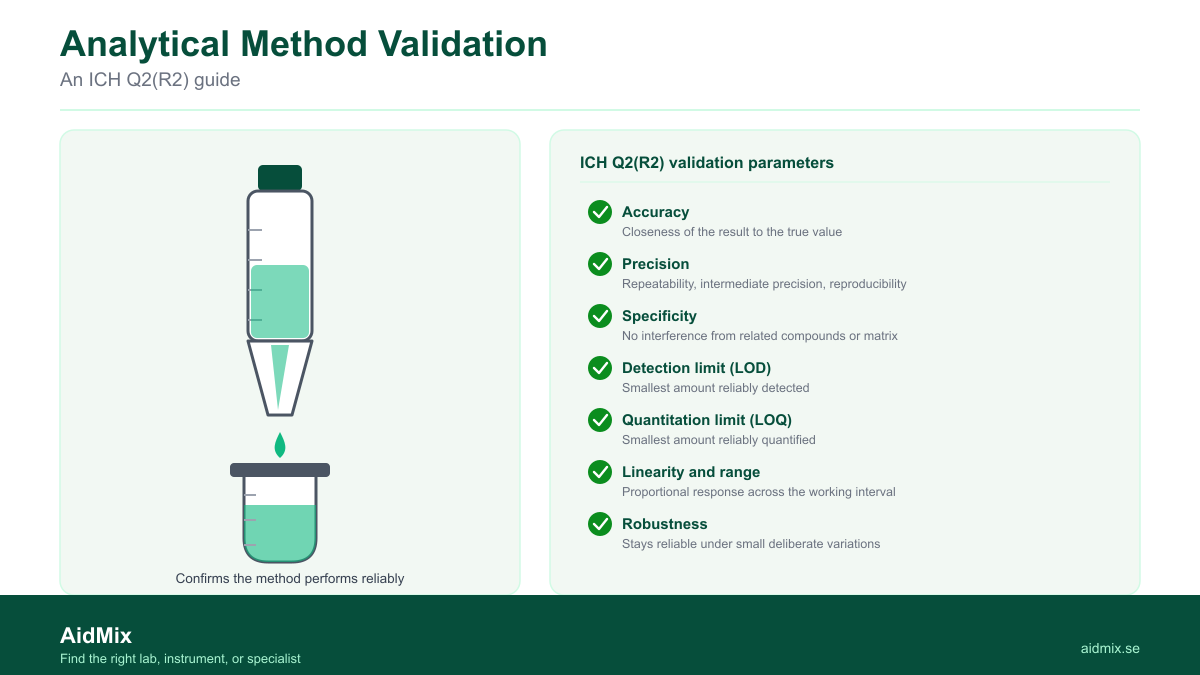
- ICH Q2(R2) defines the parameters: specificity, linearity, range, accuracy, precision, LOD/LOQ, robustness
- Required for regulated work (pharma release, submissions); optional for exploratory research
- Method development comes first; validation proves the finalised method
- GMP context matters — confirm your provider's quality system
Before an analytical result can support a regulatory decision — releasing a drug batch, backing a submission — you must show the method itself is reliable. That's method validation: a formal, documented demonstration that the procedure does what you claim, reproducibly.
The ICH Q2(R2) parameters
- Specificity — measures the analyte without interference.
- Linearity & range — proportional response across the working range.
- Accuracy — closeness to the true value.
- Precision — repeatability + intermediate precision.
- LOD / LOQ — smallest amount detectable / reliably quantifiable.
- Robustness — tolerance to small deliberate changes in conditions.
Development vs validation
Method development is designing and optimising the procedure; validation is proving the finalised method against the parameters above, with documentation an auditor can review. For bioanalytical methods supporting studies, additional expectations (matrix effects, stability) apply.
When you need it
If your data feeds a GMP release or a regulatory submission, the method must be validated. For early research, a "fit-for-purpose" qualification is often enough.
Run it on AidMix: GMP-compliant LC-MS/MS and GMP HPLC from Nordic Bioanalytical AB.
Run a bioanalytical/GMP lab? List it on AidMix for free.
Frequently Asked Questions
What guideline governs method validation?
For pharmaceutical analytical procedures, ICH Q2(R2); bioanalytical methods for studies carry additional expectations.
Do research methods need validation?
Not necessarily — exploratory research often uses fit-for-purpose qualification; formal validation is for regulated data.
What's the difference between validation and verification?
Validation proves a new method is fit for purpose; verification confirms an already-validated (e.g. compendial) method works in your lab.